
Rental vs Purchase: When does renting industrial equipment make sense?
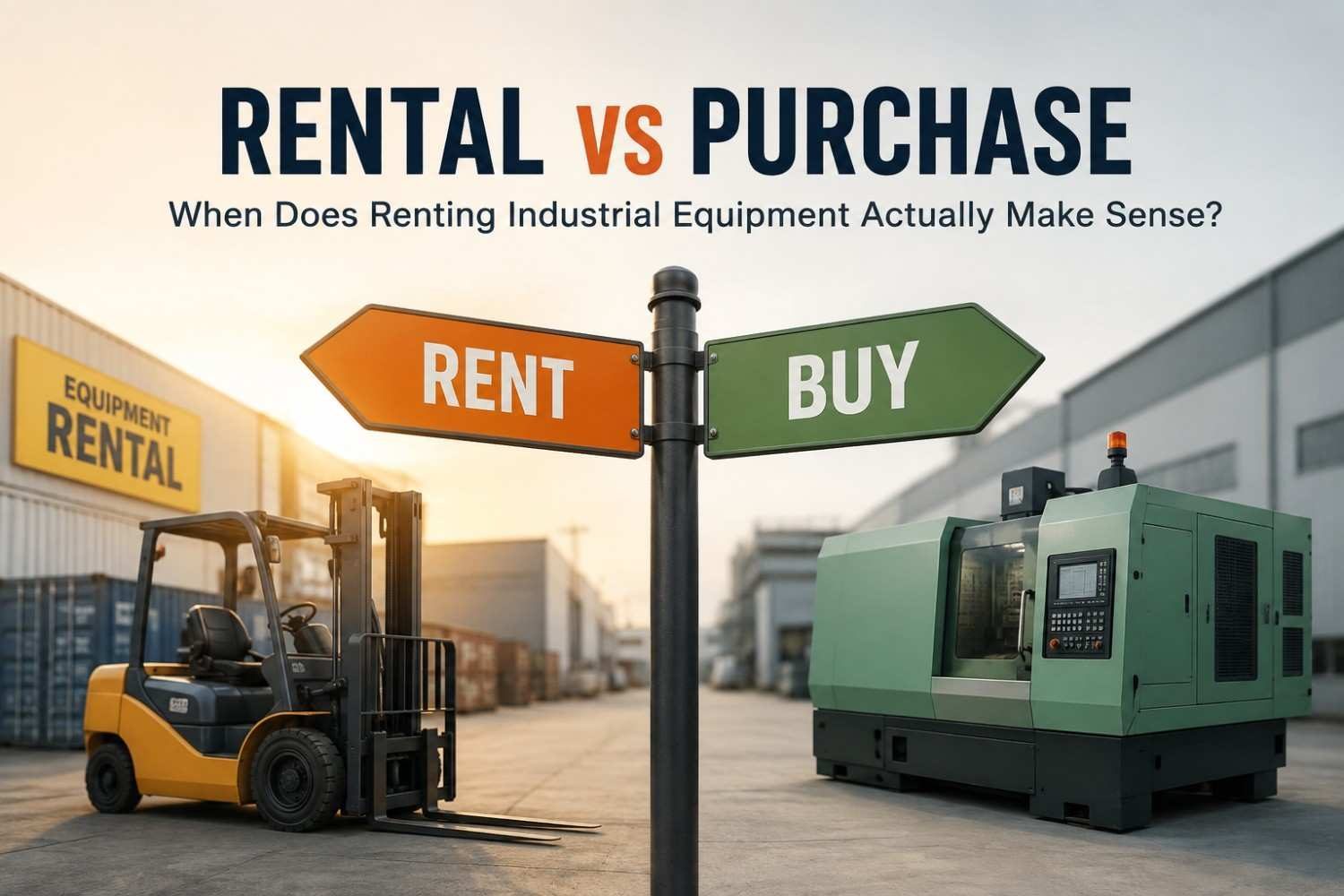
Rental vs Purchase: When Does Renting Industrial Equipment Actually Make Sense?
Rent when the job is short, seasonal, or a one-off. Buy when you'll use the equipment daily for years. Most plant managers save the most money by mixing both — renting for peak-load jobs and buying used machines for core, everyday production needs.
Let's cut to it. Every procurement guy has stood in front of a machine quote wondering: "Do I rent this thing or just buy it?" There's no single right answer. But there is a right way to think about it. That's what we're doing here.
Why Do So Many Buyers Get This Decision Wrong?
Most buyers get it wrong because they focus only on the sticker price, not the total cost of ownership. A cheap rental can bleed you dry over a year. A "pricey" used machine can pay for itself in six months.
Here's the thing nobody tells you upfront. Rental feels safe because it's a small monthly number. Purchase feels scary because it's one big number. But that's a trap. The real question isn't "which number is smaller today." It's "which option costs less over the life of the project."
If you're running a job for three weeks, renting a compressor is a no-brainer. If you're running that compressor every single day for the next five years, renting becomes the most expensive decision you'll ever make. Do the math on hours-used, not months-signed.
What Are the 3–4 Biggest Reasons Industrial Equipment Fails on the Job?
Most equipment failures come down to four things — poor maintenance history, wrong equipment-to-job matching, buying blind without inspection, and skipping verification of the seller or rental partner. Fix these four, and you dodge 90% of the headaches.
Check this out. We talked to dozens of plant and facility managers, and the same failure patterns show up again and again.
1. Poor maintenance history. A machine that looks shiny in a photo can have zero service records. You buy it, run it for two weeks, and something critical seizes up. This is the single biggest risk with used machines bought off unverified sources.
2. Wrong equipment-to-job matching. Someone buys a machine rated for light-duty work and throws heavy industrial loads at it. It's not a quality problem — it's a spec mismatch problem. This kills machines fast, whether it's heavy machinery on a factory floor or a compact CNC unit in a small workshop.
3. Buying or renting blind, with no inspection. No photos of the actual unit. No hour-meter reading. No test run. You're basically gambling. And with heavy machinery, that gamble can cost lakhs, not thousands.
4. Dealing with unverified sellers. This is a huge one. Anyone can post an ad claiming a machine is "like new." Without GST verification or any accountability trail, you have zero recourse if the machine shows up broken. This is exactly the gap a platform like IndusFact is built to close — every seller listing used industrial equipment for sale on the platform goes through human moderation, and GST-verified sellers carry a visible badge so you know who you're actually dealing with.
Anyway, once you understand these four failure points, the rent-vs-buy decision gets a lot clearer. Because rental doesn't fix problem #1 or #2 — you still need to match the right machine to the right job, rented or owned.
When Does Renting Industrial Equipment Actually Make Sense?
Renting makes sense for short-term projects, seasonal spikes, one-time jobs, or when you need to test a machine type before committing. If the usage window is under 6 months, renting almost always wins on cost.
Renting is your friend in a few specific situations. Let's list them out plainly.
Short-term or one-off projects. A three-month construction contract doesn't justify buying a crane outright.
Seasonal demand spikes. Festive season packaging surge? Rent the extra conveyor line instead of owning equipment that sits idle nine months a year.
Testing new technology. Not sure if a specific type of heavy machinery fits your process? Rent it first. Learn the ropes. Then decide if it's worth owning.
Cash flow constraints. Startups and small manufacturers sometimes need to conserve capital. Renting keeps cash in the business for other priorities.
Avoiding maintenance headaches. Most rental agreements include servicing. You don't want another asset to babysit? Renting takes that off your plate.
But here's the catch — rental costs compound. A machine that rents for ₹40,000 a month can easily cost you the equivalent of buying a solid used machine within 8 to 10 months. So if your usage is going to stretch past that window, you're basically renting yourself out of money that could've bought an asset instead.
When Does Buying Make More Sense Than Renting?
Buying wins when the equipment will run daily, for years, as part of your core operations. Owning also means no availability risk — you're not waiting on someone else's rental fleet during your busiest season.
Buying used machines instead of new ones is where the real savings show up. Here's why plant managers keep going this route.
You get long-term cost control. Once it's paid off, it's paid off. No recurring rental bill eating into margins every single month.
You avoid availability risk. Rental companies run out of stock during peak seasons — exactly when you need the equipment most. Owning your own heavy machinery means you're never stuck waiting in someone else's queue.
You can customize and modify. Rented equipment usually can't be altered. Owned machines can be retrofitted, upgraded, or repurposed as your process evolves.
Depreciation works in your favor over time, especially with well-maintained used machines that still have years of productive life left. A five-year-old CNC lathe with a clean service history can run reliably for another decade if it's looked after.
The bottom line is, if a piece of equipment is core to your daily operations — not a one-off need — buying almost always beats renting on a long enough timeline. And you don't need to pay new-machine prices to get there. Sourcing used industrial equipment for sale from a verified marketplace gets you 60–70% of a new machine's working life at a fraction of the cost.
How Do You Actually Evaluate Quality Before Buying on a B2B Marketplace?
Check the service history, verify the seller's GST status, insist on real photos and video, ask for an hour-meter reading, and never send payment before a genuine inquiry and direct conversation with the seller.
This is where most buyers either save themselves a ton of trouble or walk straight into a bad deal. Here's your checklist.
Verify the seller, not just the listing. A GST-verified badge tells you the seller is a real, registered business — not some fly-by-night reseller. Always prioritize verified sellers when browsing used machines online.
Ask for the maintenance and usage history. How many hours has it run? Was it used single-shift or triple-shift? A machine run 8 hours a day for three years is in much better shape than one run 20 hours a day for the same period.
Request real photos and, ideally, a video walkaround. Stock photos are a red flag. You want to see the actual unit, wear marks and all.
Get the specs matched to your exact job. Don't just buy "a compressor" or "a lathe." Match capacity, power rating, and dimensions precisely to your floor requirements.
Use platforms with gated contact details. This one's underrated. On IndusFact, buyer contact info stays hidden until a genuine inquiry is sent to the seller. That single feature quietly filters out a huge chunk of spam and time-wasters, so when you do connect, it's with a seller who's actually engaged and serious about the deal.
Compare Sell, Wanted, and Rent listings side by side. Sometimes the smartest move is posting a "Wanted" listing yourself and letting verified sellers with the right heavy machinery come to you.
Check this out — this whole evaluation process is exactly why moderated, verified marketplaces exist. When every listing is human-checked before it goes live, you cut out a massive chunk of the risk that comes with buying used industrial equipment for sale from random classifieds or unmoderated groups.
Rent or Buy — What's the Real Financial Breakdown?
As a rough rule, if your rental cost over 8–12 months would exceed 70% of a used machine's purchase price, buying is the smarter move. Below that threshold, renting usually wins.
Let's put real logic behind it instead of gut feeling.
Take a mid-range hydraulic press. Renting might run you ₹35,000–₹50,000 a month depending on capacity and region. A well-maintained used version of the same press could sell for ₹4–6 lakh. Do the division — you're looking at roughly 10 to 14 months of rental before you've "spent" the equivalent of owning it outright, minus any resale value you'd get from selling it later.
So ask yourself honestly: is this a 3-month job, or is this going to become a permanent part of your production line? If it's the latter, buying used machines almost always wins the math. If it's genuinely short-term, don't let anyone talk you into buying "just in case."
FAQ: Rental vs Purchase for Industrial Equipment
Q1: Is it cheaper to rent or buy used industrial equipment for sale?
It depends on usage duration. For jobs under 6 months, renting is usually cheaper. Beyond that, buying used machines almost always works out cheaper per hour of use, especially when sourced from a verified B2B marketplace at a fair price.
Q2: How do I know a used machine from an online listing isn't a scam?
Stick to platforms with GST-verified seller badges and human-moderated listings, like IndusFact. Ask for service history, real photos, and always route communication through the platform's inquiry system rather than off-platform shortcuts.
Q3: Does renting heavy machinery include maintenance?
Most rental agreements do include basic servicing, but always confirm in writing. Ownership means you control your own maintenance schedule, which many facility managers actually prefer for critical, daily-use equipment.
Q4: What's the biggest risk when buying used machines online?
Buying blind — no inspection, no verified seller, no maintenance records. That's why gated buyer-seller contact and moderated listings matter so much; they force a real conversation to happen before money changes hands.
Conclusion
Renting and buying aren't rivals — they're two tools for two different jobs. Short-term, seasonal, or unproven needs? Rent. Daily, core, long-haul operations? Buy used machines and put your capital to work instead of renting it away month after month.
Whichever way you go, the risk isn't rental-vs-purchase. The risk is dealing with unverified sellers, unclear machine histories, and zero accountability. That's the exact problem IndusFact was built to solve — GST-verified sellers, human-moderated listings, and gated contact details so you only talk to buyers and sellers who mean business.
Ready to compare options? Browse verified listings for used industrial equipment for sale, heavy machinery, and used machines on IndusFact — Sell, list as Wanted, or Rent, all in one trusted place.
Related articles
How to Choose the Right CNC Machine
Pick a CNC machine based on your material, part size, and tolerance needs first — then check the spindle power, axis travel, control system, and after-sales support. Buying a CNC machine isn't like buying a laptop. You can't just look at the spec sheet and call it a day.
Industrial Classified Site Guide: How IndusFact Works for B2B Sellers & Buyers
India’s B2B industrial classified site for used machinery, equipment, and rentals. 100% human-verified, GST badge ready, and 0% consumer clutter.