
How to Sell Surplus Industrial Equipment: A Practical Guide
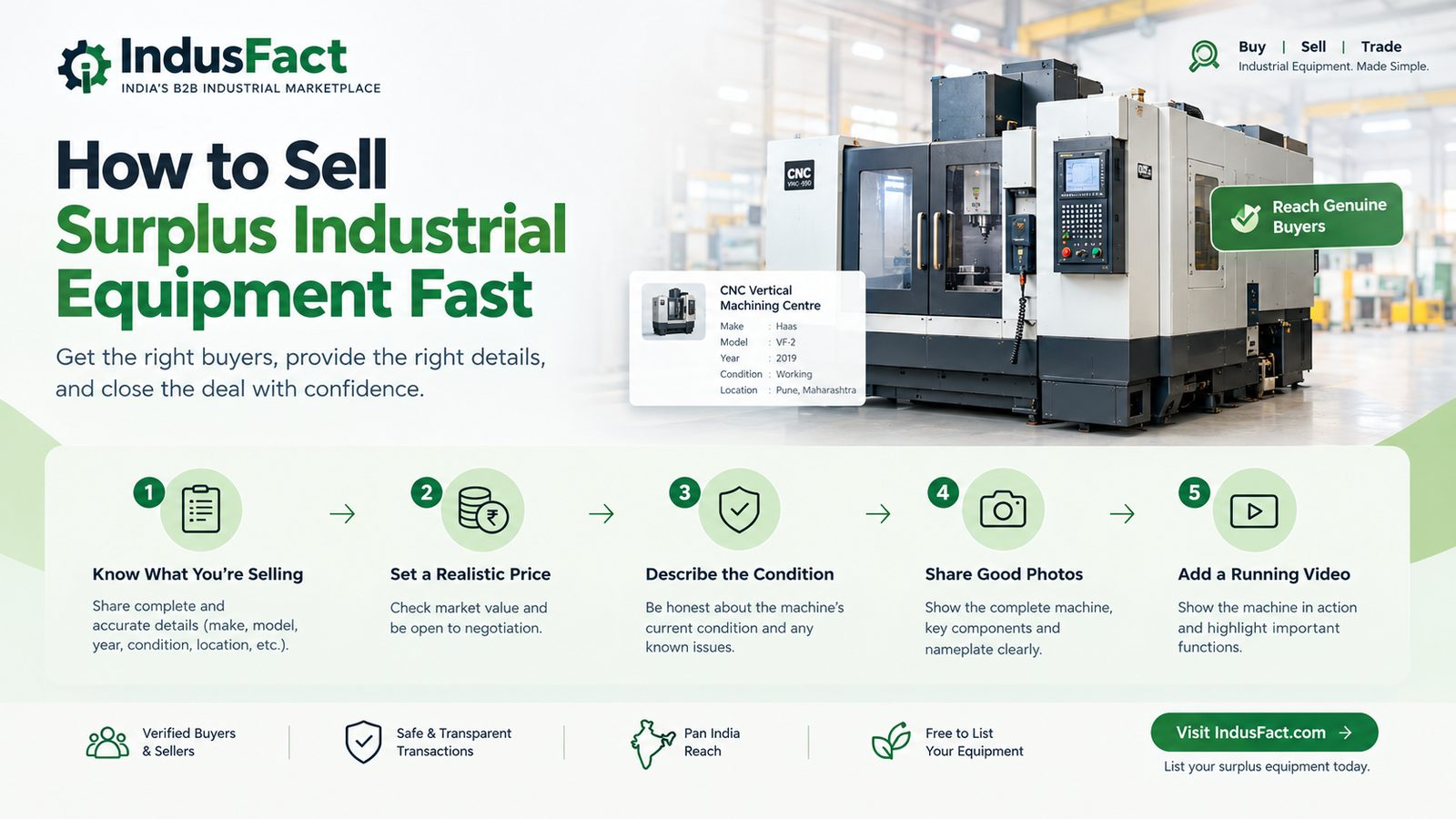
If you have a machine, production equipment, or other industrial assets that you no longer need, your first thought is simple: “How can I sell this quickly and get a fair price for this machine?” That sounds easy, but sell surplus industrial equipment is very different from selling a normal second-hand items to someone.
A buyer may want to know the machine's exact model number, year, capacity, condition, location, running status, price, and even whether they can inspect it before buying or not.
So, if you want to sell surplus industrial equipment faster, the best thing you can do is to make it easy for the right buyer to understand exactly what you are giving them.
Here is how I would approach it.
What Is Surplus Industrial Equipment?
Surplus industrial equipment is a type of equipment that a business owns but no longer needs for its operations.
For example, you may have surplus equipment because:
• You upgraded to newer machinery.
• A production line was replaced.
• A particular product is no longer being manufactured in current phase.
• Your factory has closed or moved.
• You purchased more equipment than you currently need.
• A machine is still usable, but you have no work for it anymore in your production line.
It can include CNC machines, VMCs, lathes, compressors, generators, pumps, packaging machines, printing equipment, electrical equipment, fabrication machinery, testing equipment, and complete production lines.
The important thing is this:
Your surplus equipment may be unwanted by you, but it may be exactly what another business is looking for.
The challenge is helping that buyer find it and understand it quickly.
1. Know Exactly What You Are Selling
Before putting your equipment up for sale, collect all the important details.
Do not simply write:
“CNC machine available.”
A serious buyer needs more information regarding a machine.
For example:
• Make: Haas
• Model: VF-2
• Year: 2019
• Machine type: CNC Vertical Machining Centre
• Controller: Fanuc
• Spindle speed: 8,000 RPM
• Table size: 800 × 500 mm
• Condition: Working
• Location: Pune, Maharashtra
The more accurate information you provide, the easier it becomes for a buyer to decide whether the machine is suitable for their production or not and there is another benefit You will spend less time answering the same basic questions again and again.
2. Find a Realistic Price
One of the biggest mistakes sellers make is pricing a used machine only according to what they originally paid for it.
Suppose you bought a machine for ₹20 lakh five years ago.
That does not automatically mean it is worth ₹15 lakh today.
The current value depends on many things, including:
• Age
• Brand
• Model
• Condition
• Technology
• Maintenance
• Demand
• Operating hours
• Availability of spare parts
• Current price of similar used equipment
• Cost of a new replacement
So before deciding your asking price, check what similar equipment is available for in the current market or not.
Also remember that asking price and final selling price are not always the same.
If you are open to negotiation, you can clearly mention that.
3. Be Clear About the Machine's Condition
Do not simply write:
“Excellent condition.”
That does not tell the buyer much.
Instead, explain what you actually know.
For example:
“Machine is operational and was in regular production until June 2026. Preventive maintenance was carried out regularly.”
That gives the buyer something useful.
If the machine has a known problem, mention it.
For example:
“Machine is operational, but the hydraulic pressure gauge needs replacement.”
You may think mentioning a problem will reduce interest.
Sometimes it will. But hiding the problem can waste much more time later when the buyer comes for inspection.
Be honest about the condition. A serious buyer does not expect every used machine to be perfect. They want to know what they are actually buying.
4. Take Good Photos of the Actual Equipment
Photos can make or break an industrial listing.
If possible, take clear photographs of:
• The complete machine
• Front and side views
• Control panel
• Nameplate
• Model number
• Important components
• Accessories
• Any visible damage or wear
If the machine has a nameplate, photograph it clearly.
Also, use photographs of your actual machine. A buyer wants to know what your equipment looks like today, not what the same model looked like when it was new or when it was purchased by you.
You do not need a professional camera.
A good phone camera, decent lighting, and a clean machine are usually enough.
5. Add a Running Video If Possible
For many types of industrial equipment, a short video can tell the buyer much more than photographs.
If the machine is operational, consider recording it while running.
You can show:
• The machine starting
• The control panel
• Moving parts
• Spindle or motor operation
• Production operation, where possible
• Other important functions
It does not need to look like a television commercial.
A simple, clear video is often more useful.
If the machine is not operational, do not pretend that it is working. You can still record a video showing its physical condition and important components.
6. Write a Title That Tells the Buyer What You Have
Your listing title should be clear and specific about the mahcine.
Compare these two titles:
Machine For Sale
and
Used Haas VF-2 CNC Vertical Machining Centre, 2019 Model
The second title immediately tells the buyer what the equipment is.
Whenever possible, include important details such as:
equipment type + brand + model + important identifying detail
This also helps buyers who are specifically searching for a particular machine or model.
You don't need to make the title complicated.
Just make it useful for buyers.
7. Give the Important Technical Specifications
Industrial buyers often know exactly what specifications they need.
A buyer looking for a 50 HP compressor does not want to waste time on calling sellers of 10 HP compressors.
So include the specifications that matter for your equipment.
Depending on the machine, this could include:
• Capacity
• Power
• Dimensions
• Weight
• Working area
• Spindle speed
• Motor rating
• Pressure
• Voltage
• Production capacity
• Controller
• Year of manufacture
• Operating hours
You don't need to list every technical detail you can find.
Focus on the specifications that help a buyer decide whether the equipment is suitable for their production or not write your most important specification .
8. Tell Buyers Where the Equipment Is Located
Location matters a lot when selling industrial equipment. A machine is not a small parcel that can be shipped cheaply. Dismantling, loading, transportation and installation can all cost money if the seller is not providing this compensation So tell buyers where the equipment is located.
For example:
Location: Faridabad, Haryana
You can also mention useful details such as whether the machine is installed inside a factory and whether inspection is possible in that area or not. This allows buyers to estimate the practical cost of moving it.
9. Explain Inspection and Transportation Clearly
If buyers can inspect the equipment before purchasing, say so.
For example:
“Inspection can be arranged before purchase.”
Also mention anything important about dismantling and transportation.
For example:
“Buyer will be responsible for dismantling and transportation.”
Or:
“Seller can assist with loading. Transportation will be arranged by the buyer.”
These details can prevent confusion later.
They also help serious buyers understand the actual cost of the purchase.
10. Explain Why You Want To Sell Surplus Industrial Equipment
Buyers sometimes wonder why a machine is being sold.
There is a big difference between:
and:
“Machine is being sold because we upgraded our production line.”
The second statement gives the buyer useful context. You do not have to explain your entire business. One simple sentence is enough. Of course, if you do not want to disclose the reason, that is completely fine.
11. Use the Words a Real Buyer Would Use
Think about how someone would search for your equipment.
For example, a buyer may search for:
• Used CNC machine
• Used VMC machine
• Second-hand lathe machine
If your equipment has a specific brand and model, buyers may search for that too.
For example:
“Haas VF-2 used machine”
So use the normal words buyers would actually use when describing your equipment.
But don't repeat the same keyword again and again.
Write naturally.
Your goal is not to make the listing sound like a search engine wrote it.
Your goal is to make it easy to find for a buyer to understand.
12. Don't Hide Important Information
If you know something that a serious buyer will almost certainly ask, consider putting it in the listing itself.
For example:
• Is the machine working?
• What year is it?
• Where is it located?
• What is the capacity?
• What is the asking price?
• Is inspection possible?
• What accessories are included?
• Are there any known issues?
A buyer should not have to call you just to discover the machine’s basic specifications. The more useful information you provide upfront, the more likely you are to attract serious enquiries instead of random enquiries.
13. Keep Your Listing Honest
This deserves its own point because it is important.
Do not call a machine:
“Like new”
when it has been running for ten years.
Do not write:
“Fully operational”
if an important part is not working.
Do not use photographs of a different machine.
Do not hide major defects until the inspection.
Industrial buyers usually understand that used equipment has a history.
What they don't like is discovering that the listing and the actual machine are two different stories.
Accuracy builds trust.
14. Respond Quickly When You Get a Serious Enquiry
Finding a buyer is only half of the job.
Once someone contacts you, respond as quickly as reasonably possible.
Industrial buyers often contact several sellers while looking for your equipment.
If one seller responds today and another responds after three days, the first seller already has an advantage.
Also, don't only send:
“Price is ₹8 lakh. Call me.”
Ask useful questions.
For example:
“What application do you plan to use the machine for?”
“What capacity are you looking for?”
“Do you need installation support?”
This helps you understand whether the buyer is actually looking for your equipment or the buyer is just browsing.
15. Be Ready for Inspection and Negotiation
A buyer may want to inspect the equipment before making a final decision.
Keep the machine accessible and, where possible, keep relevant documents or manuals ready.
If the equipment is operational, be prepared to demonstrate it.
Also expect some negotiation.
That does not necessarily mean your asking price is wrong.
Industrial buyers usually consider the complete cost:
machine price + dismantling + loading + transportation + installation + repairs
So a buyer may make an offer based on the total investment they will need to make.
Listen to the reasoning behind the offer before rejecting it immediately.
What Makes an Industrial Listing More Likely to Get the Right Buyer?
If I had to simplify the entire process, I would focus on five things:
1. Give the right information
Tell buyers exactly what the equipment is.
2. Show the real condition
Use genuine photographs and, when possible, a running video.
3. Price it realistically
Look at the current market instead of only remembering the original purchase price.
4. Remove unnecessary questions
Give buyers the specifications, location, condition and other important details upfront.
5. Respond to genuine enquiries quickly
A good listing can bring the buyer to your door. The rest depends on how you handle the conversation.
Quick Checklist Before You Publish Your Listing
Before you post your surplus equipment for sale, check:
☐ Correct equipment name
☐ Brand and model
☐ Year of manufacture
☐ Important specifications
☐ Actual condition
☐ Working status
☐ Real photographs
☐ Nameplate photograph
☐ Running video, if possible
☐ Asking price
☐ Equipment location
☐ Inspection details
☐ Transportation/dismantling information
☐ Included accessories
☐ Known problems or defects
☐ Clear reason for sale, if you want to mention it
☐ Correct category
☐ Clear listing title
Final Thought
Selling surplus equipment is not about simply putting a machine online and hoping someone calls you. The right buyer needs enough information to say:
“Yes, this is the machine I am looking for.”
Your job is to make that decision easier.
Show the actual machine. Give accurate specifications. Mention its condition. Be clear about the price and location. Explain the practical details. And most importantly, don't hide the problems.
You may have only one machine to sell, but somewhere there may be a business actively looking for exactly that machine.
The better you explain what you have, the easier it becomes for that buyer to find